Soy Boy
Cut the root open and it is red inside.For the same reason your blood is.
A working soy root has little lumps on it. Cut one in half and it is pink to blood red inside. The colour comes from a protein with an iron atom in the middle that grabs oxygen and hands it over in measured amounts. That is haemoglobin. Yours does the same job with the same mechanism.
A plant and an animal, arriving separately at the same answer. A farmer can tell whether the plant is working by the colour. Grey means it has stopped.
Legume Hub, biological nitrogen fixation.
- Glycine max

The good boy
hi hi hi. soy boy here.
i have one job. i am the ink. the little logo on your label and on your insole. that is me. that is all me. i printed it. did you see it.
one job, and i do it without solvents, doing the least harm i can, even when nobody is watching. which is always. because i am ink.
The good stuff
What the factory needs 500 degrees for
Four fifths of the air is nitrogen, and proteins are made of nitrogen. There are about eight tonnes of it above every square metre of ground. Almost nothing alive can use it, because the two atoms are locked together by one of the strongest bonds in chemistry.
Humans solved that with force. The industrial process runs at 400 to 500 degrees and 150 to 250 times atmospheric pressure. It takes one to two per cent of all the energy used on earth. About half the nitrogen in your body has been through it.
The soy plant solved it by hiring help. Its roots put out a chemical advert and a soil bacterium answers. The root curls around the bacteria and builds them a house. It pays rent in sugar: up to sixteen per cent of everything it makes in a season. In that house, in the mud, in the dark, at ordinary temperature and pressure, the bond breaks.
Legume Hub; Haber-Bosch energy share, Royal Society 2020
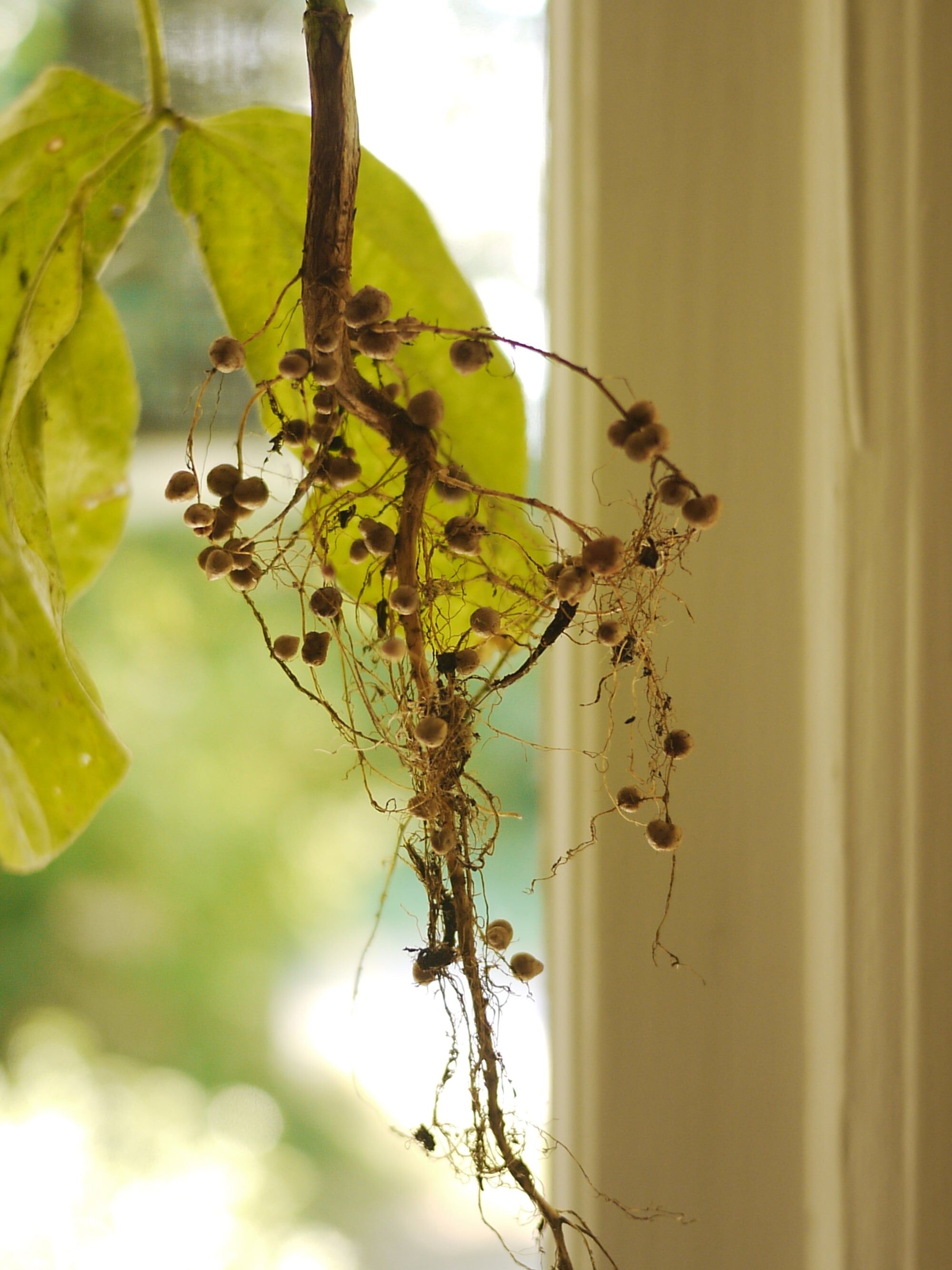
Glycine max root nodules · Isarnan · Public domain (resized)
The good stuff
Oxygen is both the poison and the fuel
The enzyme that breaks that bond is wrecked by oxygen. Not slowed down, permanently destroyed. But the bacteria have to breathe to power the reaction in the first place. They need the thing that kills them.
That is what the red protein is for. It holds oxygen tightly enough to keep the enzyme safe and lets just enough through for the bacteria to breathe. The plant built a blood substitute to solve a contradiction.
Journal of Agricultural Science.
The good stuff
Henry Ford wore a suit made of this
In the 1930s Ford became obsessed with the soybean. From 1935 there was about a bushel of them in the paint and the plastic parts of every car that came off his line. They went into horn buttons, gear knobs, distributor caps and accelerator pedals. In 1934 he gave a press dinner where every course contained soy. For almost everyone at the table it was the first soybean of their life.
In August 1941 he unveiled a car with a body of fourteen pressed plastic panels on a steel tube frame. It was hundreds of kilos lighter than steel. That year he was given a birthday suit that was a quarter soy fibre. The car never went into production and the war arrived.
Crops as materials is not a new idea. It is an old idea that got pushed out of the way.
The Henry Ford, Soy Bean Car
Nothing left over
From a bean to a logo
- Cracked and flaked
- The beans are cracked, warmed and rolled thin.
- Separated
- The oil comes out. What is left goes to animal feed, and that is most of the value, so the oil is the by-product.
- Cooked
- The oil is polymerised into something thicker and more resinous, so it has the right stickiness for a press.
- Made into ink
- The oil is the vehicle. Pigment, resins, waxes and driers go into it. The vehicle carries the pigment onto the material and then hardens by reacting with oxygen from the air into a flexible, transparent, water-resistant film.
- Printed
- Onto the label and the insole.
One practical consequence: this dries more slowly than petroleum ink, because it sets by reacting rather than by evaporating.
The good stuff
“Soy ink” almost never means all soy
Ink is a vehicle plus pigment, resins, waxes and driers. Only the vehicle is soy, and even that is often mixed. The American industry seal for “soy ink” needs at least 40 per cent soy oil in black newspaper ink. In heatset it is as little as 7 per cent. An ink can be called soy ink and be ninety-three per cent something else.
So we will not print a percentage until our supplier gives us the measured bio-based content in writing. When they do, it goes on the passport.
What we can say: the vehicle is a plant oil rather than a mineral oil. Because it is clearer, the pigment reads brighter with less of it.
Journal of Agricultural Science.
The good stuff
Most soy does not end up in ink
Seventy-seven per cent of the world's soy goes to feeding animals. Seven per cent is eaten by people directly. The oil is a side stream of a protein industry, and that industry is one of the largest users of land on earth. The Cerrado is the most species-rich savanna in the world. More than a third of it has been fully converted, and only about eight per cent is properly protected.
Using a side stream of that is defensible. Claiming that our ink steers any of it is not, and we are not going to.
Our World in Data, soy; WWF Cerrado assessment
What's in your pair
The measured bio-based content of our ink is not on this page, because we do not have it in writing yet. When we do, it goes on the passport.
This page is about the material. It is not about your pair.
Which of it is in the pair you own, which part of the shoe it sits in, how much of it by weight, who made it and in which country: that is on the passport of that pair. Every box carries a code. Scan it and you get the list for that pair. And when a component changes, the passport changes with it. This page does not.
Before you worry
How much of the ink is actually soy?
We are asking, and when we have it in writing it goes on the passport. See the block above for why that question is less simple than it sounds.
Will it rub off?
No. It hardens by reacting with the air into a film, rather than drying off a solvent.
The cast