
Candy Cotton
One fibre. One cell.A thousand times longer than it is wide.
A cotton fibre is a single cell, grown out of the skin of a cotton seed. It stretches to more than 25 millimetres while staying about 0.02 millimetres wide. Scale a person up like that, with shoulders 45 centimetres across, and you would be 450 metres tall. One cell. No joins.
- Gossypium

The one doing all the detail work
candy. cotton.
quick question. the laces you tied this morning. the lining your foot goes into. the small stitches, the label on the tongue, the embroidery you liked in the photos.
who do you think does all of that.
me. all of it. i am everywhere you do not look. without me a shoe is a sole and a good intention.
The good stuff
The twist that lets you tie a lace
While the cotton boll is still closed, each fibre is a round, juicy tube. The plant winds its wall in spirals, and every so often the spiral flips and winds the other way.
Then the boll splits open. The cell dies and dries fast. The hollow middle collapses, the tube flattens into a ribbon, and because the wall is wound like a double spring, the ribbon twists. At every flip point it twists the other way.
That is why you can spin cotton. A smooth rod would slide straight out of a yarn. A corkscrew that changes direction every few millimetres hooks into its neighbours and grips. You can tie your laces because a cell in a field dried out and turned.
Cotton Physiology, Cotton Foundation, chapter 23
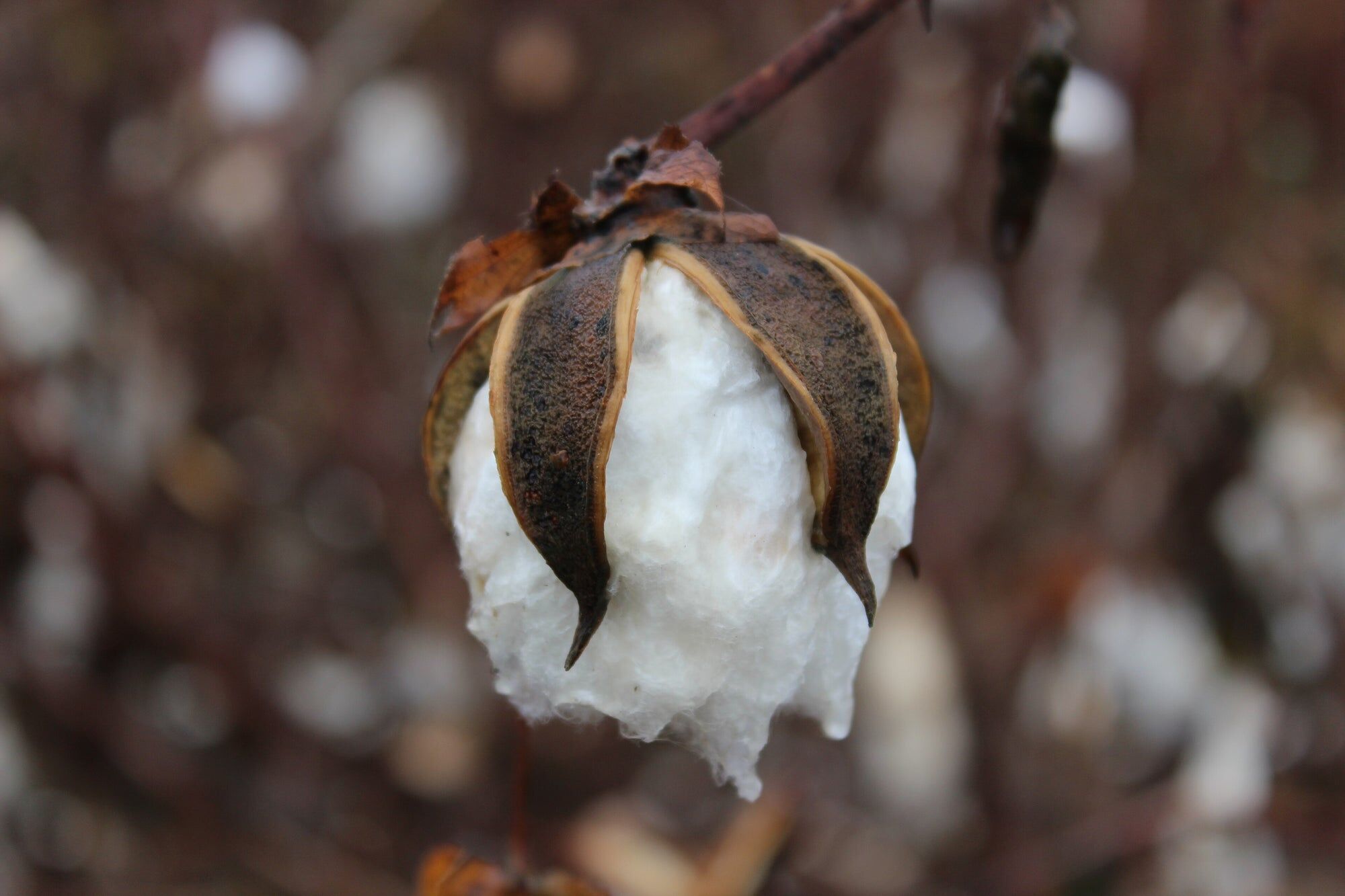
Cotton boll nearly ready for harvest · Michael Bass-Deschenes · CC BY 2.0 (resized)
The good stuff
Your shoe is a hijacked parachute
The plant is not making fluff for us. It is making it so the seed can catch the wind or hook onto an animal. The boll bursts, the fluff swells into a cloud, and the seed leaves.
On one seed there are ten to twenty thousand fibres. In one boll there are around half a million, all separate cells that decided to do the same thing at the same time. We took a seed-dispersal system and spun it.
Cotton Incorporated / CottonWorks
The good stuff
Europe thought lambs grew on stems
Medieval Europe had wool from sheep, linen from flax and silk from a caterpillar. Then travellers came back describing cloth from wool that grew on a plant. German still carries the confusion: Baumwolle, tree wool. For four hundred years Europe explained it with little lambs growing on stems. Sir John Mandeville described a gourd-like fruit you cut open to find a tiny lamb inside.
In 1698 Hans Sloane unwrapped a specimen and found a fern root, turned upside down and trimmed into a lamb. The real thing was a cotton boll. Eighteen centuries before Mandeville, Herodotus had written that in India wool grows on trees. No lamb. He just looked.
Henry Lee, The Vegetable Lamb of Tartary, 1887; Herodotus III.106
The good stuff
Invented four times, by people who never met
Cotton was domesticated at least four separate times, from four different species, on three continents: southern Africa and Arabia, the Indus valley, Mexico and Peru. Nobody involved knew about anybody else.
And in Peru they were dyeing cotton with indigo six thousand years ago, about fifteen hundred years before the oldest blue in the Old World. The first blue denim was Peruvian.
Splitstoser et al., Science Advances 2016
it does not go straight. the little fibres curl and kink and refuse to lie flat, and that is the whole reason the lace holds. every one of those kinks is a cell that dried out and turned.
The good stuff
The part of my history nobody puts on a label
Cotton has the heaviest history of anything in this shoe, and we will not skip it.
In 1794 Eli Whitney patented a machine that pulled the seeds out of cotton. By hand it took hours to clean a pound. The machine did fifty pounds a day. The result was not less work but far more cotton, and for that, people were needed. In 1790 there were 697,624 enslaved people in the United States. In 1860 there were nearly four million, and America grew three quarters of the world's cotton. Close to ninety per cent of the cotton spun in Lancashire came from those plantations.
In 1960 the Aral Sea covered 68,000 square kilometres. Soviet planners sent the two rivers that fed it to cotton fields. By 2010 it had lost ninety-one per cent of its water.
None of that is about our cotton. It is about this plant, and a brand that wants you to find a material wonderful does not get to pretend it has no history.
US National Archives, Prologue 2004; Science and Industry Museum Manchester; Applied Water Science 2, 2012
Nothing left over
How a cell becomes a lace
- Flowers
- White, pink within two days, then it drops. What is left is the boll.
- Stretches
- Cells on the seed coat extend past twenty-five millimetres, a thousand times their own width, in a few weeks.
- Winds
- Cellulose laid down in spirals, with flip points.
- Opens and dies
- The twist appears.
- Ginned
- Fibre separated from seed.
- Spun
- Laid parallel and twisted. The kinks hook into each other.
- Mercerised
- Pulled through caustic soda under tension. The fibre swells, the kinks pull straight, and you get shine, more strength and better dye uptake.
Where thread comes from
Cotton, and the thread from oil
| Cotton | Polyester thread and lace | |
|---|---|---|
| What it is | a single cell of almost pure plant fibre | a filament from oil |
| Wet | 10 to 20 per cent stronger when wet, which almost nothing else is | unchanged, forever |
| Against skin | soft against skin without any finish | needs one |
An average sneaker holds about three quarters of a litre of crude oil.
Cotton fibre is 87 to 90 per cent cellulose, and 99 after washing.
TRAID / Footwork, 2018. The Guardian.
Nothing left over
The numbers of a single cell
- 1 cell
- is what a cotton fibre is
- 25 mm
- long, about 0.02 mm wide
- about 1,000x
- longer than it is wide
- 10,000 to 20,000
- fibres on a single seed
- about 500,000
- fibres in one boll
- 1.4%
- of all cotton grown was organic in 2020/21
Frontiers in Plant Science 2012; CottonWorks; Textile Exchange
What's in your pair
Organic cotton was about 1.4 per cent of all the cotton grown in the world in 2020/21. That is the material, not us.
This page is about the material. It is not about your pair.
Which of it is in the pair you own, which part of the shoe it sits in, how much of it by weight, who made it and in which country: that is on the passport of that pair. Every box carries a code. Scan it and you get the list for that pair. And when a component changes, the passport changes with it. This page does not.
So what is it for
Everywhere you do not look
The laces, the lining, the stitches, the label. A shoe without cotton is a sole and a good intention.
Before you worry
How much water does cotton use?
More than we would like and less than the number you have probably seen. The 20,000 litres per kilo that goes round online comes from a 1999 report. The latest measurement, at 271 locations in 38 countries between 2020 and 2024, comes to 6,238 litres per kilo of fibre. Three quarters of that is rain that fell on the field anyway. The irrigation part is about 1,593 litres. It varies hugely by region, so one global number says little.
What does the organic certificate actually prove?
It certifies the whole chain with yearly audits, bans a list of chemicals and sets rules for waste water and working conditions. It does not prove anything about water use or carbon, and says nothing about the other materials in the shoe. Anybody who says organic cotton means less water is going beyond the certificate.
Do cotton laces get weaker in the rain?
The opposite. Cotton is one of the very few fibres that gets stronger wet, by ten to twenty per cent.
The cast
Meet the cast
-
 Rupert Rubbersole
-
 Flora Flaxthread
-
 Candy CottonlacesYou are here
-
 Harry Hempcanvas
-
 Eugene Eucalyptupper
-
 Maisy Mushroomupper
-
 Kenny Kenafinsole
-
 Soy Boyink


