
Rupert Rubber
Pull it and it gets stronger.Cut it and it heals itself.
Pull a plastic bag and it goes thin, then it rips. Pull rubber and the opposite happens: the long strands swing into line, and the spot about to tear turns hard. It defends itself right when it is about to break.
Cut the tree and it does the same trick. Within two hours the cut has sealed itself. Nobody helped.
This is the tree under your feet.
- Hevea brasiliensis

The one holding it all together
rupert here. rubber.
i'm the bit between you and the pavement, and the bit that stops the top of your shoe from walking off without the bottom. the others will have warned you that i never stop talking. rude. also true.
before any of that i was ten atmospheres of pressure inside a trunk. then somebody opened me with a knife at four in the morning.
shall i tell you why it had to be four in the morning.
The good stuff
The tree makes its own scab
Latex is not sap. Sap is the tree's food, moving around. Latex sits in its own tubes in the bark and stays there. The tree keeps it for emergencies. An insect that bites a leaf gets a mouthful of glue.
Those tubes are under pressure: ten atmospheres, about three times what is in a car tyre. So the first minutes after a cut run fastest.
Then the flow stops by itself, usually within one to three hours. The tree has not run out. Tiny bags float in the latex, and when it starts moving they burst. What spills out makes the rubber clump and plug the tubes. Halfway through, seven out of ten tubes are already shut.
Your sole is that repair, caught before it finished.
Yeang, Journal of Natural Rubber Research
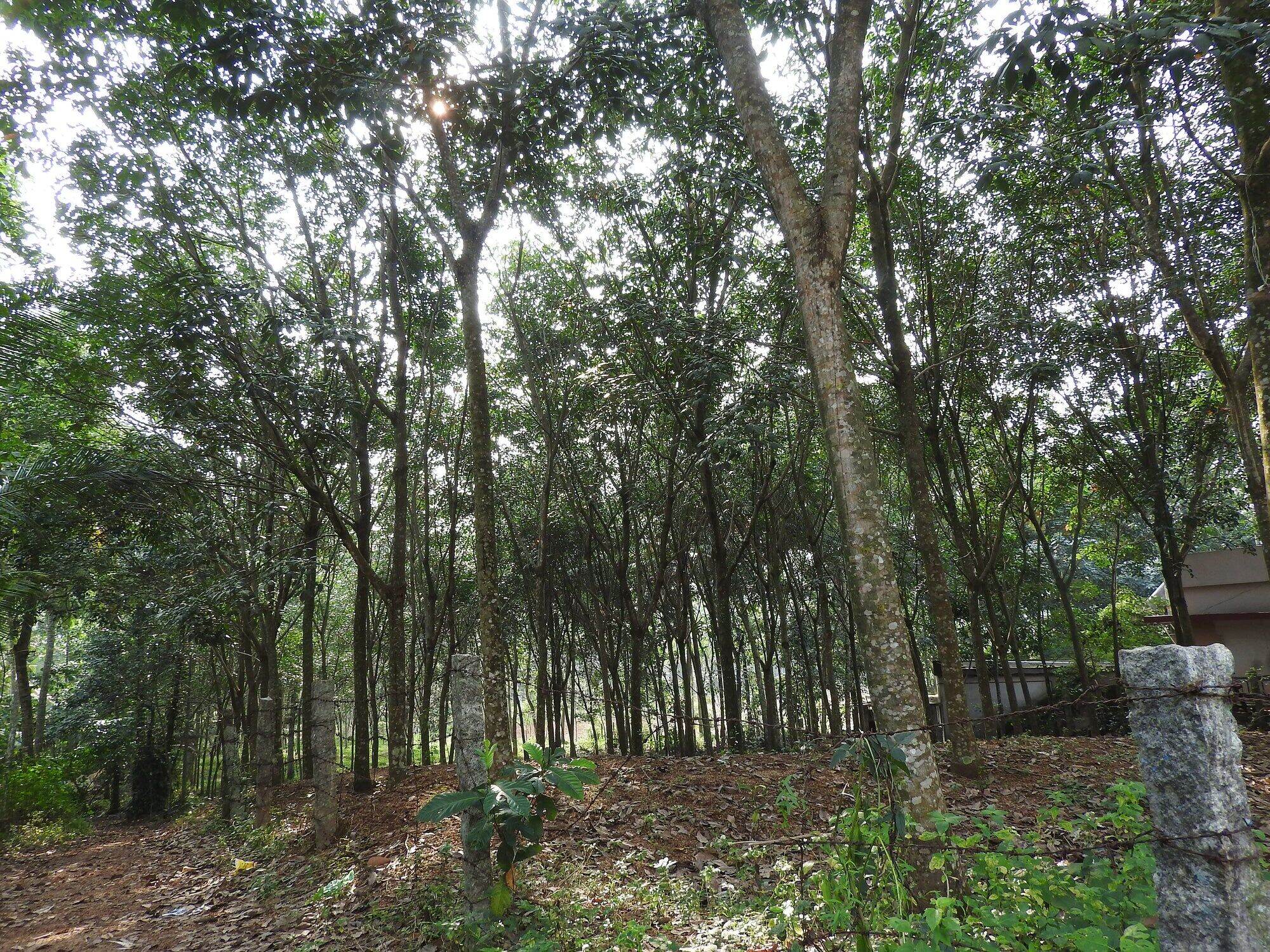
Hevea brasiliensis-1-kottor-kerala-India · Yercaud-elango · CC BY-SA 4.0 (resized)
The good stuff
The whole skill is an angle
The tubes do not run straight up. They spiral around the trunk, about thirty degrees off level. A cut straight down would cross almost none of them. A cut that slopes across the spiral crosses as many as possible in one stroke.
The tapper shaves off bark about as thick as the edge of a coin, one and a half millimetres. That happens around 150 times a year on the same tree. Always before sunrise, when the pressure inside is highest. Start at eleven in the morning and the same tree gives a third less.
FAO, Tapping means
The good stuff
Nearly every rubber tree in Asia is a cousin
In 1876 Henry Wickham shipped about seventy thousand seeds out of the Amazon to Kew. About 2,400 came up. Almost every rubber tree in Asia descends from that handful. By 1908 Malaya had ten million of them.
It worked because the seeds left their disease behind. South American leaf blight never crossed the ocean. The whole world economy of rubber rests on one fungus that stayed where it was.
Kew; Oxford Plants 400
take an elastic band. stretch it fast and hold it against your lip. it is warm. let it shrink and it goes cold.
that is not friction. that is me putting my own molecules in order, and order has to come from somewhere. it is the same thing i do under your heel, all day, every step.
Nothing left over
From a cut to a sole
What comes out of the tree is about a third rubber. The rest is mostly water, plus some protein, sugar and fat. The rubber itself is tiny balls. Five thousand fit side by side across a millimetre.
- Tapped
- One cut, one cup, before sunrise.
- Stabilised
- Something is added so it does not set on the way to the factory.
- Concentrated
- Water out, rubber stays.
- Tied together
- The long strands get fastened to each other. This is the step that turns a liquid into something you can walk on. Chemists call it cross-linking. Charles Goodyear found it in 1839 by dropping rubber on a hot stove.
- Shaped
- Into the thing under your foot.
Which of those steps happened where, and to the rubber in your pair, is on its passport.
Where thread comes from
Rubber, and the thing from oil
| Natural rubber | Synthetic rubber, from oil | |
|---|---|---|
| Comes from | a tree that keeps making more | a barrel that does not |
| Under strain | long, even strands that lock up exactly where it is about to tear | never locks up |
| Supply | the EU lists it as a critical raw material and cannot make it | no shortage, and no tree |
An average sneaker holds about three quarters of a litre of crude oil.
Ninety-eight percent of all sneakers contain synthetic materials. Some soles are still in the ground a thousand years after someone stopped wearing them.
SCRREEN critical raw materials factsheet; Michelin Natural Rubber (industry source)
Nothing left over
What one tree gives
- 6 to 7 years
- before the first cut
- 20 to 30 years
- of tapping, and then the tree comes down
- 150 cuts
- a year
- 60 to 150 kg
- from one tree in its whole working life
- 1,196 kg
- per hectare per year, average 2012 to 2016
- 85%
- of world production from smallholders
SCRREEN for area and yield; FAO for the cut; Michelin (industry source) for trees, kilos and smallholders
Wat er in jouw paar zit
About 85% of the world's natural rubber comes from smallholders. That is the material, not us.
Deze pagina gaat over het materiaal. Niet over jouw paar.
Wat ervan in jouw paar zit, in welk onderdeel, hoeveel ervan in gewicht, wie het maakte en in welk land: dat staat in het paspoort van dat paar. Op elke doos staat een code. Scan hem en je krijgt de lijst voor dat paar. Verandert er een component, dan verandert het paspoort mee. Deze pagina niet.
You are probably standing on oil right now
Not a metaphor. Look down. If those are ordinary sneakers, the sole under you came out of a barrel. It will still be a sole long after you have forgotten buying it.
Ours comes off a tree that makes more. Two runs a year, spring and autumn, and we make yours after you order it.
Before you worry
Does tapping kill the tree?
No. The tree closes a cut by itself, and the tapper opens it again one stripe lower. A tree is tapped for twenty to thirty years. Then it stops producing and gets felled. That is the one honest problem with rubber.
Is the sole just tree sap?
No, and we will not pretend it is. Latex is stabilised, concentrated and cross-linked before anything is shaped. Which sole is in your pair, and what share of it is natural rubber, is on its passport.
Why does it smell?
Because it came out of a plant and it kept its proteins and fatty acids. It fades.
The cast
Meet the cast
-
 Rupert RubbersoleYou are here
-
 Flora Flaxthread
-
 Candy Cottonlaces
-
 Harry Hempcanvas
-
 Eugene Eucalyptupper
-
 Maisy Mushroomupper
-
 Kenny Kenafinsole
-
 Soy Boyink


