
Kenny Kenaf
A stalk that was grown to stand up.Now it holds you up.
Cotton makes its fibre as fluff on the seed, so the seed can fly. Kenaf makes its fibre in the stem, so the plant can stand.
In four months it reaches five metres. At its fastest it grows eight centimetres a day.
This is the plant under your foot.
- Hibiscus cannabinus
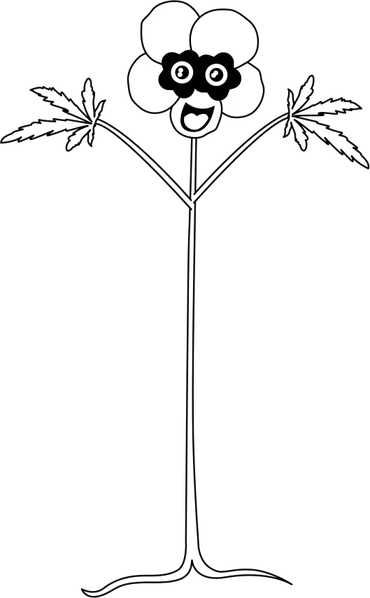
Grown to stand up
kenny here. kenaf.
i'm the layer you never see, between your foot and the floor. people mix me up with hemp. i get it. the name is a misunderstanding.
i grow eight centimetres on a good day. i have been standing up for a very long time.
shall i tell you who i am actually related to.
The good stuff
Two cousins, two ways to make a fibre
Cotton and kenaf are cousins, from the same plant family. They solve the same problem in opposite ways.
Cotton grows its fibre on the seed, as fluff that lets the seed drift away. You harvest the way it reproduces.
Kenaf grows its fibre in the stem, in the bark, like a cable that keeps the plant upright while it shoots up to five metres. You harvest its skeleton.
One cousin makes fibre to fly. The other makes fibre to stand. Per fibre, the stander is usually the stronger, in published measurements.
PROSEA; Polymers 2022, 14(19), table 1
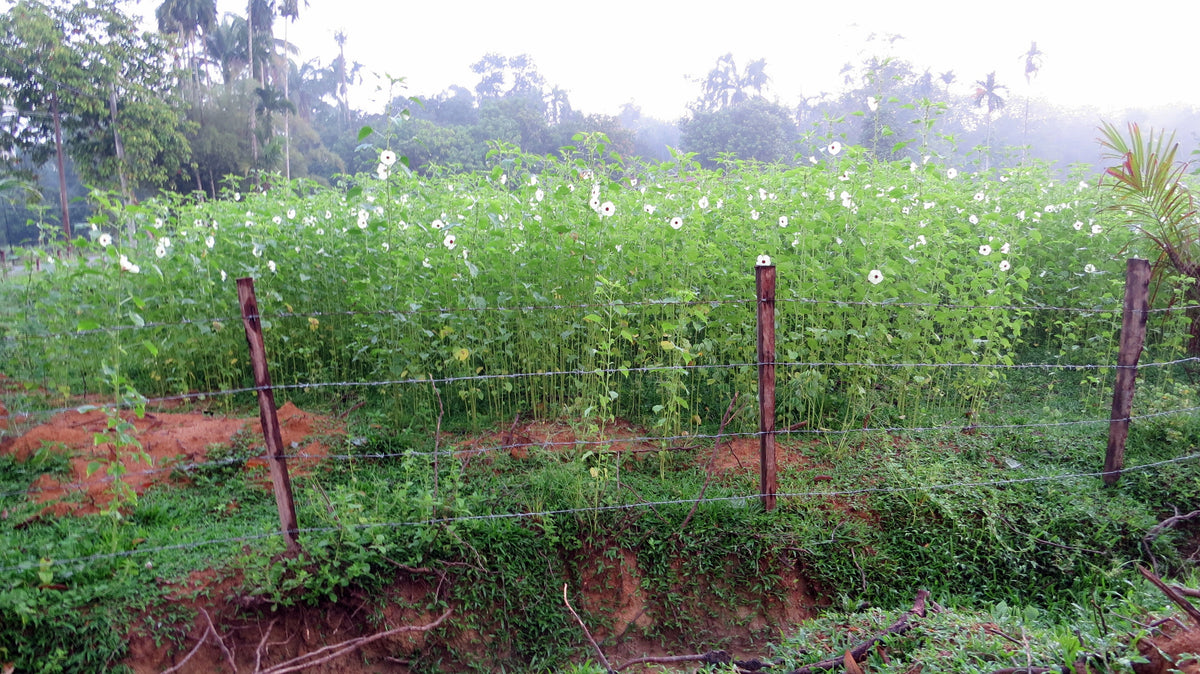
Kenaf or Jute grown in Malaysia · Tu7uh · CC BY-SA 4.0 (resized)
The good stuff
One flower, one morning
A kenaf flower opens just before sunrise and is closed by the afternoon. It never opens again. It is cream to yellow, seven to ten centimetres across, with a blood red heart.
As it closes, the petals curl in a spiral and press the pollen against the part that receives it. If nothing has pollinated it by then, it can pollinate itself.
Flax does the same trick with its flower. Two unrelated plants in one shoe, and both give you a flower for one morning.
PROSEA monograph; USDA, Insect Pollination of Cultivated Crop Plants
five petals, a dark heart in the middle. kenaf has the same face.
and if you ever meet the flower itself, go before noon. after that it is closed, for good.
The good stuff
The same fibre is in a car door
In January 2012 Ford put kenaf in the door bolsters of its new Escape, mixed half and half with polypropylene. That made the bolsters 25 per cent lighter.
Dräxlmaier, a car parts maker, reported in 2014 that a kenaf door carrier for the BMW i3 weighs 1,980 grams per square metre. The plastic version weighs 3,320.
Almost nobody knows the name of this plant.
Ford press release, 26 January 2012; Dräxlmaier, ATZ worldwide 116(06), 2014
The good stuff
The stem is two materials
Break a kenaf stem open and you hold two things. The outside is bark: long, strong fibre, about a third of the stem. The inside is a pale core: short fibres around a soft pith, about two thirds.
The bark holds things up. The core is a sponge. Ground up, it soaks up about six times its own weight in water over a few days.
One plant, two raw materials. The core ends up in animal bedding and oil spill clean-up.
PROSEA; Byrd, TAPPI Pulping Conference 1999
Nothing left over
From a stem to a layer
Kenaf is sown thick, like flax and hemp, so the plants race upward and make stem instead of branches. It stays leafy while the days are longer than about twelve and a half hours.
- Sown
- Seed that sprouts in two or three days in warm, damp soil. Crowded on purpose.
- Grown
- Four to five months, up to five metres. At its fastest, eight centimetres a day.
- Cut
- At the start of flowering, when the stem is heaviest and still soft.
- Retted
- Microbes eat the plant glue (pectin) that holds bark to core. The modern way strips the bark first and soaks only that, with far less water.
- Split
- Bark and core are separated. Two streams, nothing thrown away.
- Bound
- Washed, dried, cut to length and laid into a loose web. A fibre spun from fermented corn starch is mixed through it. The web is needled into a felt, then warmed until that fibre softens, well below the point where plant fibre is harmed. It melts at the crossing points and solders the kenaf together. Cooled under pressure to thickness, then cut to the shape that sits under your foot.
This is the same trick as flax and hemp: let something rot on purpose so the fibre lets go.
One thing said plainly. There is no latex and no glue in this. But what holds it together is an industrial polymer, melted in. That is something other than fibre alone, so we say both.
Where thread comes from
Kenaf, and the foam from oil
| Kenaf fibre | Synthetic foam | |
|---|---|---|
| Comes from | a stem that grows five metres in four months | a barrel that does not |
| Where it grows | warm places, roughly between 45 degrees north and 30 south | a factory |
An average sneaker holds about three quarters of a litre of crude oil.
Kenaf is a long, bendy fibre with a lot of strength and little stiffness of its own. So it is felted and bonded to hold a shape. This layer takes a step a few thousand times a day and has to keep its thickness. For that, it is the right kind of material.
FAO Ecocrop; PROSEA
Nothing left over
What one hectare gives
- 120 to 150 days
- from sowing to fibre harvest
- about a third
- of the stem is bark, the part we use
- 1.2 tonnes
- of dry fibre per hectare, world average 1997 to 2001
- 254,100 tonnes
- grown worldwide in 2016/17
- 140,000 and 55,000
- of those in India and China
- 2.8 million tonnes
- at the peak, in 1985
FAO Ecocrop; PROSEA; FAO Statistical Bulletin 2017; Agronomy 2024
The good stuff
Who actually does this work
Kenaf is grown mostly in India and China, largely by smallholders, and the money in it is thin. American farm budgets reckon on about 55 dollars a ton of stalk. Water retting loads the water with organic matter; ribbon retting and machine stripping use much less. We ask our suppliers which method was used and where the fibre comes from. What they answer goes on the passport of the pair, not here.
Two things you will read about kenaf that deserve a correction, and you should hear them from us. “Grown without pesticides”: for insects, mostly true, because you harvest the stem and not the fruit, and the usual pests rarely cost yield. Root-knot nematodes are another matter; they sit on the crop's list of real problems. And “absorbs more CO2 than any other plant”: that figure traces back to a 1995 news item with no study behind it. The carbon leaves again at harvest, as it does with every annual crop. We do not say it.
University of Kentucky, AGR-172; PROSEA; Agronomy 2024, 14(7)
Wat er in jouw paar zit
Kenaf grows mostly in India and China today. The world grew 2.8 million tonnes of it in 1985 and 254,100 in 2016/17. That is the material, not us.
Deze pagina gaat over het materiaal. Niet over jouw paar.
Wat ervan in jouw paar zit, in welk onderdeel, hoeveel ervan in gewicht, wie het maakte en in welk land: dat staat in het paspoort van dat paar. Op elke doos staat een code. Scan hem en je krijgt de lijst voor dat paar. Verandert er een component, dan verandert het paspoort mee. Deze pagina niet.
So what is it for
The layer you never see
Plenty of insoles are foam from a barrel. This layer started as a stem that grew five metres in four months. You will never see it. That is rather the point.
Before you worry
Does it smell?
No. It is washed, dried and cleaned before it gets anywhere near a shoe.
Is it hemp?
No. The name means “like hemp”, and Linnaeus gave it in 1759 because of the leaves. Hemp is in a different family, closer to hops. Kenaf is in the family of cotton and okra.
The cast
Meet the cast
-
 Rupert Rubbersole
-
 Flora Flaxthread
-
 Candy Cottonlaces
-
 Harry Hempcanvas
-
 Eugene Eucalyptupper
-
 Maisy Mushroomupper
-
 Kenny KenafinsoleYou are here
-
 Soy Boyink


