
Eugene Eucalypt
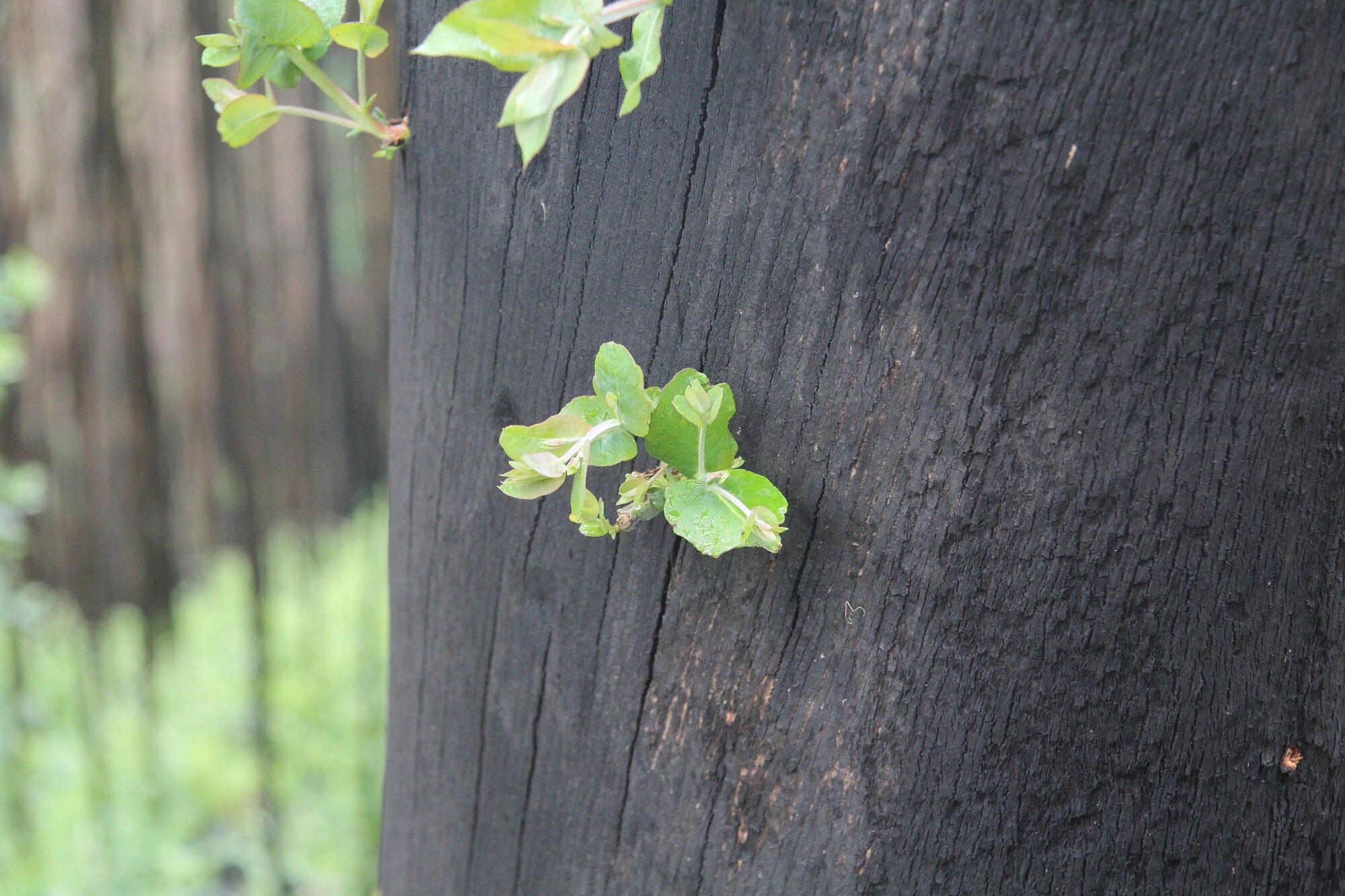
Burn it down and it comes backout of the trunk itself.
Almost every tree in the world keeps its spare buds in the outer bark, where a fire destroys them. Eucalypts keep theirs deep, below the thickest layer of bark, pressed against the living wood.
So a few weeks after a fire a black, apparently dead trunk sprouts green along its entire length. New shoots can put on twenty-seven centimetres in a day. Australians call them toothbrush trees.
Burrows, New Phytologist 2002.
- Eucalyptus

The overachiever
eugene. eucalypt. pleasure.
let me get the numbers out of the way, because they are good and i am proud of them. i grow fast. i barely drink. and when they dissolve me and spin me back out again, i become the soft part of your upper.
the others say i am an overachiever. i prefer thorough.
The good stuff
Every flower comes with a lid
Eucalyptus means “well covered”, from the Greek. A French botanist named it in the 1780s after looking at a dried specimen from Cook's third voyage. What struck him was the lid: the flower bud sits under a cap made of fused petals.
The cap pops off, and what is underneath is not a petal at all. It is an explosion of stamens. Everything beautiful about a eucalyptus flower is the working part. There is no decoration on it anywhere.
EUCLID, Eucalypts of Australia, CSIRO
Eukalyptus auf Madeira im Dezember 2016 · GerritR · CC BY-SA 4.0 (resized)
The good stuff
The tallest flower on earth dies to come back
Eucalyptus regnans is the tallest flowering plant on earth. The tallest living one, in Tasmania, is 100.5 metres. Young ones grow more than two metres a year for their first twenty years.
Here is the twist: this species does not do the trick in the hero. It has no underground reserve and does not survive a serious crown fire. The parent trees die, their seed falls into the ash, and the whole forest comes back at once, all the same age. It has no way to survive. It has a way to die and return in the same movement.
EUCLID, Eucalypts of Australia, CSIRO
The good stuff
We cannot eat a tree. A cow rents a stomach.
Cellulose is sugar: glucose strung in a long line. Starch is the same, except one link is turned the other way round. That single detail is the difference between food and building material. We have no enzyme that opens that link, so cellulose goes through us unchanged, and we call it fibre. A cow has no such enzyme either. It rents a stomach full of microbes that do.
The most common organic material on the planet, and hardly anything can get it open. That is exactly why it is good to build with.
Journal of Agricultural Science.
The good stuff
Mother-in-law silk
In the 1880s a French engineer working on a silkworm disease left photographic chemicals out in his darkroom and came back to find threads. He pushed the syrup through something like a shower head and had filaments, shown at the Paris exposition of 1889.
One problem: the stuff was nitrocellulose, the basis of gun cotton. It was so flammable that factory workers called it mother-in-law silk. It took another century and a solvent you can recover to reach what is in this shoe. Material science is not a press release. It is a long, embarrassing, human business.
Journal of Agricultural Science.
Nothing left over
Dissolved, not rebuilt
- Wood
- Eucalyptus from certified forestry, usually on six to eight year rotations.
- Chipped and pulped
- The wood is cooked down until over ninety per cent cellulose is left. About a third of the wood survives as pulp.
- Dissolved
- The pulp goes into a warm solvent (NMMO) and turns into something like honey. Nothing is chemically rebuilt.
- Spun
- The honey is pushed through jets and set in a water bath, and the cellulose falls back out as a fibre.
- Washed, dried, cut, baled
- About two hours from pulp to bale.
Older viscose breaks the cellulose down and rebuilds it with carbon disulphide. That chemical poisoned many workers in the twentieth century and is still in use. This route only dissolves the molecule and lets it set again. The maker states that over 99.8 per cent of the solvent is recovered and reused.
The 99.8 per cent figure is the fibre producer's own statement, not an independent measurement.
Where thread comes from
Dissolved cellulose, and the older routes
| Dissolved cellulose | Viscose and polyester | |
|---|---|---|
| The molecule | dissolved, never rebuilt | broken down and rebuilt |
| Solvent | recovered and reused, per the maker | carbon disulphide, with a documented history of nerve damage in workers |
| Where it starts | a tree | a tree, or a refinery |
An average sneaker holds about three quarters of a litre of crude oil.
Ninety-eight percent of all sneakers contain synthetic materials. Some soles are still in the ground a thousand years after someone stopped wearing them.
TRAID / Footwork, 2018. The Guardian.
Nothing left over
The numbers of a tree that will not stay dead
- nearly 900
- species of eucalyptus
- 1
- of them grows naturally outside Australia
- 100.5 m
- the tallest living one, in Tasmania
- 27 cm
- of new shoot in a single day after fire
- 6 to 8 years
- rotation for pulpwood
- about 2 hours
- from pulp to finished fibre bale
EUCLID, CSIRO; UNESCO World Heritage listing, Greater Blue Mountains Area
Wat er in jouw paar zit
The forestry and fibre certificates belong to the fibre, from the company that makes it. They do not transfer to a finished shoe. What is certified for the pair you own is on its passport.
Deze pagina gaat over het materiaal. Niet over jouw paar.
Wat ervan in jouw paar zit, in welk onderdeel, hoeveel ervan in gewicht, wie het maakte en in welk land: dat staat in het paspoort van dat paar. Op elke doos staat een code. Scan hem en je krijgt de lijst voor dat paar. Verandert er een component, dan verandert het paspoort mee. Deze pagina niet.
So what is it for
The soft part of your upper
Dissolved, spun, washed, cut. Two hours from pulp to bale, and then it is the part your foot rests against.
Before you worry
Where does the wood come from?
Not from Australian forest, in almost all cases. Eucalyptus for pulp is grown on plantations elsewhere, and those plantations have their own arguments attached about water, monoculture and fire. We tell the tree's story without pretending the wood came off a mountain in Tasmania.
Is it a plastic?
No. It is cellulose, the same material as cotton and paper, dissolved and set again. Nothing is built out of oil.
Does the certificate cover the shoe?
No, and this is worth being precise about. The forestry and fibre certificates apply to the fibre, from the company that makes it. They do not transfer to a finished shoe. What is certified for the pair you own is on its passport.
The cast
Meet the cast
-
 Rupert Rubbersole
-
 Flora Flaxthread
-
 Candy Cottonlaces
-
 Harry Hempcanvas
-
 Eugene EucalyptupperYou are here
-
 Maisy Mushroomupper
-
 Kenny Kenafinsole
-
 Soy Boyink


